


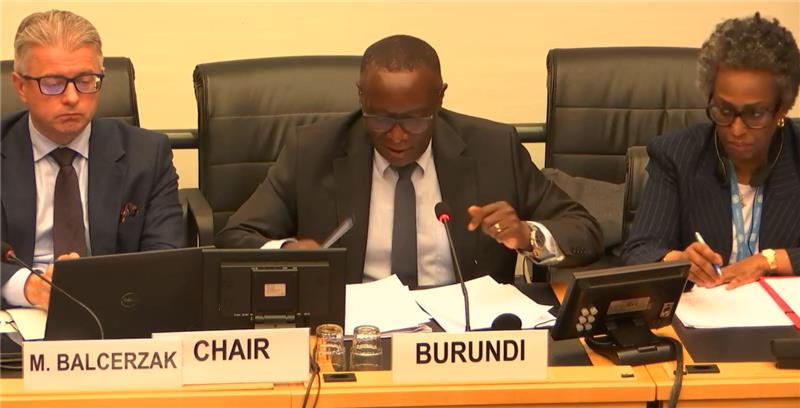
Between Legal Framework and Ground Reality: Key Contradictions Highlighted During Burundi’s Review by CERD
During Burundi’s review by the United Nations Committee on the Elimination of Racial Discrimination (CERD) on 24 and 25 November 2025, several civil society organizations, including ACAT-Burundi, supported by FIACAT and OMCT, submitted an alternative report. This report shed light on the situation of human rights defenders, the dissolution of multiple independent NGOs, and the concerning conditions under which Burundian journalists operate.
While the government delegation, whose report had been awaited since 1998, emphasized a strengthened legal framework and the establishment of institutions meant to guarantee the fight against discrimination, the alternative report by civil society highlighted contradictions between this legal and institutional architecture and the daily reality experienced by those working for the protection and promotion of fundamental rights. Civil society organizations stressed that many independent groups have been struck off for years or continue to face administrative and security obstacles that paralyse their work. Many of their leaders still live in exile under the constant threat of arrest, intimidation, or smear campaigns designed to silence critical voices.
Human rights defenders are among the most vulnerable in this context. The report notes that those who attempt to document enforced disappearances, acts of torture, or structural discrimination are regularly targeted. Some have been forced to flee the country, while those who remain work in constant insecurity, aware that their commitment may expose them to direct retaliation. This reality stands in sharp contrast to the official narrative, which claims to guarantee an open and inclusive civic space.
The situation of journalists is equally problematic. The alternative report describes a largely controlled media landscape, where suspensions, threats, and restrictions on access to information are common. International bodies have, in recent years, noted a significant deterioration in press freedom. During the review, the Committee questioned the Burundian delegation about concrete measures taken to protect journalists, prevent arbitrary arrests, and guarantee media independence. The State’s responses were often viewed as insufficient, relying more on general principles than on effective protective mechanisms.
Dialogue with CERD experts also highlighted the lack of independent investigations into the violations reported by civil society. Organizations reiterated that as long as those responsible for intimidation, assaults, or arbitrary arrests are not prosecuted, institutional reforms cannot truly rebuild trust between authorities and independent actors. Persistent impunity fuels fear, restricts civic participation, and weakens mechanisms aimed at preventing discrimination.
By providing precise and well-documented insights into the realities faced by defenders, NGOs, and journalists, the alternative report enriched Burundi’s review before CERD beyond the technical aspects of legislation. It underscored that combating discrimination cannot be separated from protecting those who expose abuses and ensuring an open civic space. The Committee took note of these concerns, and expectations now run high for its final recommendations, which must stress the need to protect independent actors and restore an environment conducive to freedom of expression and the work of human rights organizations.
By highlighting these key issues, Burundian civil society organizations reaffirm their essential role: giving a voice to victims, tirelessly documenting violations, and reminding all that justice, transparency, and freedom of expression and information are the indispensable foundations of a society truly committed to combating discrimination.